Well pump replacement in Tifton and Tift County
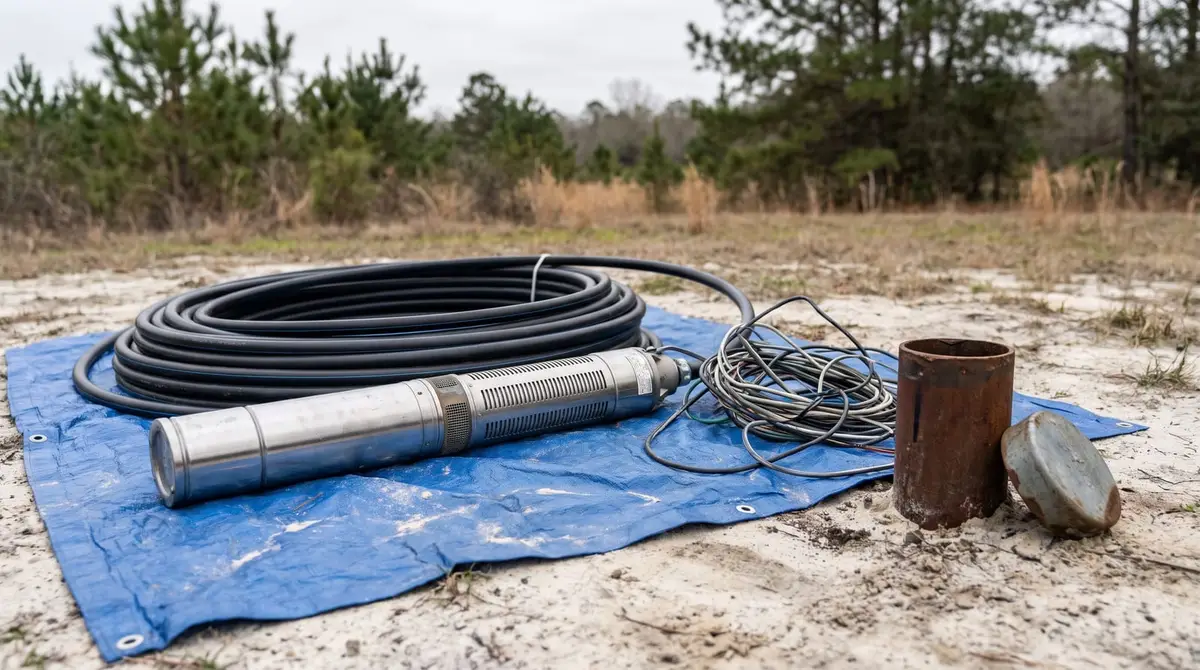
Most home wells in Tift County are drilled down into the Floridan limestone, and a drilled well that deep is normally served by a submersible pump hanging inside it. When that pump dies, the house is dry until it is pulled and replaced. SepticAndWell.com's 2026 Georgia cost guide puts a full replacement on a shallower Coastal Plain well like most here at about $800 to $1,800, all in. Plenty of "dead pump" calls turn out to be a $150 switch or a $200 control box, though, so the cheap parts get tested first.
Call (229) 520-5205Rather not call? Send the detailsCalls are answered 24/7. Weekdays 9 to 6 you may be put straight through to a local pro. Nights and weekends, if it can't wait, say so and we'll ring a local pro right away; otherwise a local pro will call you back the next business morning.
Is my well pump really dead, or is it something cheaper?
Often it is something cheaper: a pressure switch, control box or tank can make a good pump look dead. A pump near the end usually shows one of these signs:
- It runs but the pressure never builds: The gauge by the tank creeps up slowly or stalls short of the shut-off number, and showers get weaker week by week.
- It trips the breaker as it starts: The breaker for the well snaps off the moment the pump tries to start, every time it is reset.
- It hums or does nothing at all: The breaker holds, the switch clicks, and no water comes.
A quick way to tell which side the trouble is on: if the gauge by the pressure tank reads low, it is on the well side (the pump, the pipe in the well, the pressure switch or the tank). If the gauge reads normal but the faucets are weak, look at the house side: filters, a softener or old pipes.
Every one of those can also come from the pressure switch, the control box on the wall, or the wire at the top of the well. A careful pro tests those at the surface before anyone pulls a pump, because pulling it is the expensive part.
What wears out pumps in Tift County wells?
Sand and iron are two of the big ones. The Georgia cost guide this site uses says pumps in wells with sandy water, high iron or acidic water wear out faster. The ground under Tift County starts as a sand and clay mix, and the state geologic survey found local cases of excess iron in the area's well water.
Hard starts wear pumps too. A pressure tank that has lost its air makes the pump start and stop far more often than it should, and each start heats the motor. If a new pump goes in, a tired tank should be looked at the same day.
Water levels matter in a dry year. In the 2007 drought, the U.S. Geological Survey reported that numerous home wells in south-central Georgia were "going dry," and owners had to have pumps lowered or new wells drilled. A pump that has been sucking air near the top of the water works harder and fails sooner.
How deep do Tift County home wells go?
There is no single number. Georgia's geologic survey describes the ground here as a sand and clay layer, less than 50 feet thick in places and several hundred feet in others, sitting on top of the Floridan limestone. Most home wells are drilled through that sand and clay and finished in the top few feet of the limestone, and the depth to that limestone can change by tens of feet over a short distance. Your neighbor's well is a hint, not an answer.
The best answer is on paper. Georgia law requires the driller to give the owner the well's construction data within 30 days of finishing it, so an old drilling record, or the invoice from the last pump job, usually lists the depth and where the pump hangs.
What happens when a submersible pump is replaced?
- Test first: Power at the switch and control box, the current the motor draws, and the wire's insulation are checked from the surface to confirm the pump is the problem.
- Pull it: The crew lifts the pipe, wire and pump out of the casing, usually with a pump hoist on a truck.
- Look at what came up: Rusted pipe, nicked wire or a clogged intake screen are replaced while everything is out of the ground, and the pump setting can be lowered if the water level has dropped.
- Set the new pump: The new pump and a check valve go on, the wire splice is sealed, and the string is lowered back down.
- Run it in: The pro brings the system up to pressure, watches the pump shut off at the right number, and checks the current again.
Many replacements are finished the same day. Ask the pro to leave the depth they set the pump at in writing, for next time.
How much does a new well pump cost around Tifton?
As a rough 2026 guide, SepticAndWell.com's Georgia survey puts the all-in cost of replacing the pump in a shallower Coastal Plain well at about $800 to $1,800. The same guide lists motor burnout, impeller wear and age as the usual reasons a pump needs replacing. Deeper wells cost more.
| Job | Rough cost |
|---|---|
| Submersible pump replacement, shallower Coastal Plain well | $800 to $1,800 |
| Jet pump replacement | $500 to $1,200 |
| Well pipe repair or replacement | $300 to $1,500 |
| New wire on a deep well | $100 to $400 |
| Pressure tank replacement | $300 to $800 |
| Control box replacement | $200 to $500 |
| Pressure switch replacement | $150 to $350 |
Pump contractors in the same guide bill about $75 to $150 an hour, and after-hours or weekend service often costs 50% to 100% more than a scheduled visit.
Ask for the pump, labor, pipe, wire and any tank as separate lines, so two quotes can be compared honestly.
Common questions
How fast can a well pump be replaced?
Once a crew is on site, often within a few hours. Stuck pipe, a pump that broke loose and fell, or a hard-to-reach wellhead take longer.
Should the pressure tank be replaced at the same time?
Only if it has failed or is close to it. If water comes out of its air valve, or the pump was clicking on and off every few seconds before it quit, replacing the tank protects the new pump.
Can a pump be set deeper instead of drilling a new well?
Sometimes. After the 2007 drought, the USGS noted that owners of wells that went dry had pumps lowered or new wells drilled. Whether lowering works depends on how much water stands above the bottom of the well.
Sources: Georgia Geologic Survey, T. W. Watson, The geohydrology of Ben Hill, Irwin, Tift, Turner, and Worth Counties, Hydrologic Atlas 2 (1976) (source); U.S. Geological Survey, Hydrogeology and impact of pumping on shallow water-bearing zones and the Upper Floridan aquifer, south-central Georgia (source); Georgia Code § 12-5-134 (drilling notice, setbacks, well construction data) (source); SepticAndWell.com, Georgia well pump repair cost (updated April 10, 2026) (source).
Last reviewed November 11, 2026.
Rather not call? Send the details
A local well pump pro will call you back.