Submersible or jet pump: which one is in your Tift County well?
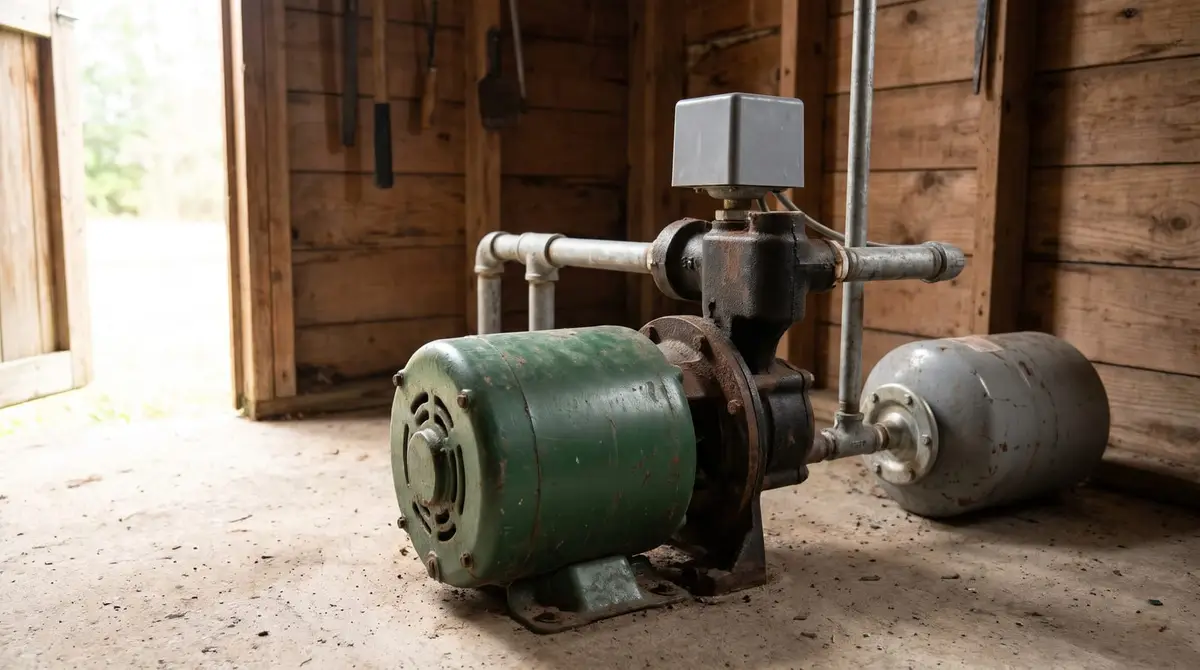
A submersible pump lives down in the well and pushes water up to the house. A jet pump sits above ground, in a pump house or crawl space, and pulls water up by suction. Suction only reaches so far, which is why drilled wells into the Floridan limestone under Tift County almost always use submersibles.
Call (229) 520-5205Rather not call? Send the detailsCalls are answered 24/7. Weekdays 9 to 6 you may be put straight through to a local pro. Nights and weekends, if it can't wait, say so and we'll ring a local pro right away; otherwise a local pro will call you back the next business morning.
Which pump do I have?
- Look beside the tank: A pump with a round electric motor bolted to it, plumbed to the tank, is a jet pump.
- Look at the wall: If you find only the tank, a pressure switch and perhaps a gray control box on the wall, the pump is down in the well: a submersible.
- Listen: A jet pump hums loudly when it runs. A submersible is close to silent from the house.
Why do most Tift County wells use submersibles?
Because of how deep the water-bearing rock is. Georgia's geologic survey says most home wells here are drilled through a layer of sand and clay, from under 50 feet to several hundred feet thick, and finished in the top of the Floridan limestone. A pump catalog from Red Lion lists shallow-well jet pumps for water up to about 25 feet down, convertible jet pumps or submersibles from 25 to about 90 feet, and only submersibles beyond that.
The water here is under pressure, though. The same survey explains that it rises in a cased well above the level where the driller first hit it, so the water can stand much higher in the casing than the depth of the well. How far down that water stands, and how far it drops in a dry summer, decides which pump can reach it.
The Georgia cost guide this site uses notes that jet pumps are less common in Georgia. You are most likely to find one on an older, shallow well.
How do the two pumps compare?
| Submersible | Jet pump | |
|---|---|---|
| Where it is | Down in the well on pipe and wire | Above ground beside the tank |
| Reach | Anything past 25 feet, and the only choice past 90 (Red Lion) | About 25 feet (shallow-well), about 90 feet (convertible) |
| Sound | Quiet | A steady hum while it runs |
| Priming | Never | Must stay full of water; air leaks make it lose prime |
| Service | Pulled out of the well with a hoist | Easy to reach and work on |
| Rough replacement, Georgia 2026 | $800 to $1,800 (shallower Coastal Plain well) | $500 to $1,200 |
What goes wrong with a jet pump?
Losing prime is the classic call. Air gets in through a leaking suction pipe, a loose fitting or a worn foot valve at the bottom of the pipe, and the pump spins without moving water. Run that way it overheats, so shut it off and have the leak found.
Jet pumps also sit in the open air of a pump house, where summer heat, dust and wasps all get at the motor. Goulds, a large jet pump maker, says its jet pumps all ship with the switch set at 30/50.
What goes wrong with a submersible?
Mostly the motor, the wire or the parts that start it. On a three-wire pump, the starting parts live in the control box on the wall, which can fail and leave the pump looking dead. Franklin Electric, a major motor maker, says lightning-induced surges can damage any submersible motor and calls for a surge arrestor on every installation.
When the pump itself fails, it has to come up out of the well. That is why it pays to test the switch and control box first.
Can I switch from a jet pump to a submersible?
Often, if the casing is wide enough for a submersible to fit. It makes sense when a house has outgrown an old jet pump or the water level drops too far in summer for suction to reach. A pro checks the casing size and the water level first.
Common questions
Do both pumps need a pressure tank?
Yes. Either kind fills a pressure tank, and a pressure switch on the pipe tells it when to run.
Is a bigger pump better?
No. A pump sized beyond what the well gives can pull the water down faster than it refills, and it starts and stops more often. Match the pump to the well and the house.
Where do I find my pump's size?
On a jet pump, the motor label. On a submersible, a tag in the control box, the pump installer's invoice, or the well record.
Sources: Georgia Geologic Survey, T. W. Watson, The geohydrology of Ben Hill, Irwin, Tift, Turner, and Worth Counties, Hydrologic Atlas 2 (1976) (source); Red Lion, Pump and tank selection guide (pump type by depth) (source); Goulds Water Technology, Jet pump installation manual (switch settings) (source); Franklin Electric, Submersible motor application, installation and maintenance manual (source); SepticAndWell.com, Georgia well pump repair cost (updated April 10, 2026) (source).
Last reviewed November 11, 2026.
Rather not call? Send the details
A local well pump pro will call you back.