New well drilling in Tifton and Tift County
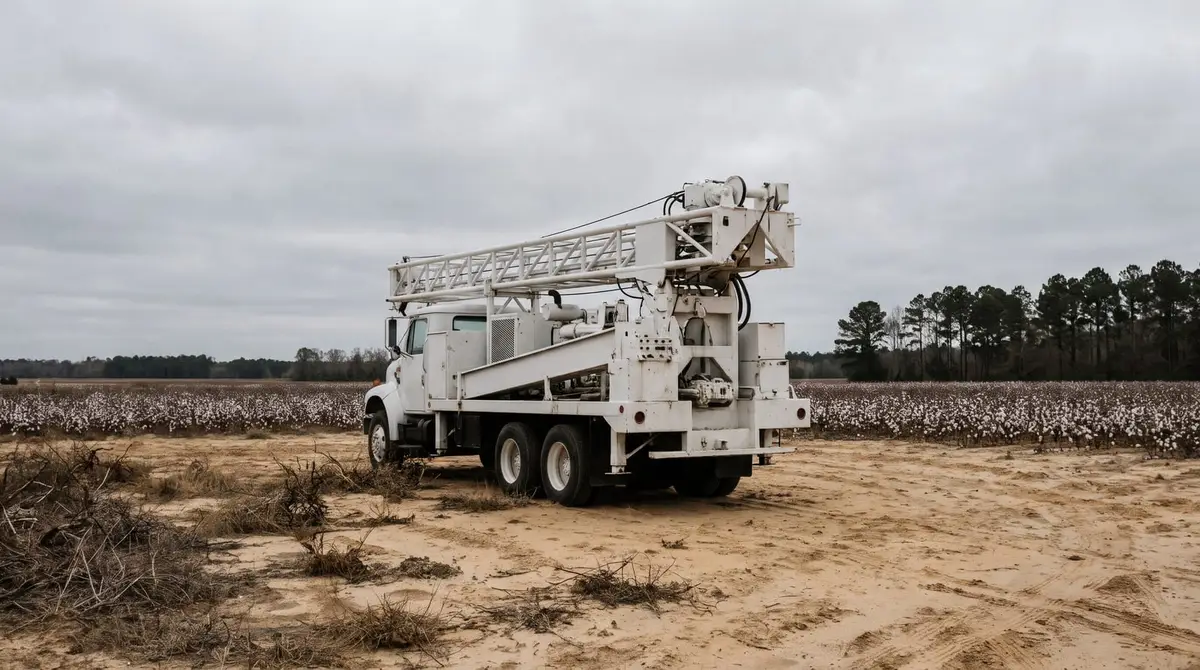
Under Tift County, the water a home well needs sits in the Floridan limestone, buried beneath a blanket of sand and clay. A new well is drilled through that blanket into the top of the rock. How deep that is changes from one lot to the next, which is why drilling is priced by the foot and the final bill is only known once the rig finds good water. As a rough 2026 guide, Coastal Plain drilling runs about $18 to $28 a foot, and a shallow Coastal Plain well may come in under $10,000 all in.
Call (229) 520-5205Rather not call? Send the detailsCalls are answered 24/7. Weekdays 9 to 6 you may be put straight through to a local pro. Nights and weekends, if it can't wait, say so and we'll ring a local pro right away; otherwise a local pro will call you back the next business morning.
When is a new well the right call?
When an old well keeps sputtering or going dry in summer, when sand or sediment keeps coming in through failed casing, when the water quality cannot be fixed with treatment, or when you are building where there is no water line.
Before deciding, have the old well measured and the water tested. A lower pump setting or a new pump sometimes saves it; after the 2007 drought, the USGS noted that owners in south-central Georgia either lowered pumps or drilled new wells.
What is under the ground in Tift County?
Georgia's geologic survey mapped Tift and four neighboring counties in 1976. The top layer is a sand and clay mix laid down by ancient seas, from less than 50 feet thick to several hundred feet, and quite thick in southeastern Tift County. Below it lies what the survey calls the principal artesian aquifer, now called the Floridan: mostly the Suwannee and Ocala limestones, about 250 feet thick in the northwest of the mapped area and more than 400 feet in the southeast.
The top of that limestone is rough, eroded and pitted with old sinkholes, so the depth to rock can change by tens of feet within a short distance. In southern Tift County the survey found a buried low spot where the limestone is missing or much deeper and filled with tight clay, and high-yield wells there are commonly hard to finish.
Most home wells are drilled through the sand and clay and finished in the top few feet of the limestone. Bigger users drill wider or deeper; tests on Tifton's city wells showed large wells can give 1,000 gallons a minute or more.
The water is under pressure, so it rises in the casing above where the driller first hits it. The USGS reports that water levels in the region's Floridan wells move with rainfall and with pumping.
What is the water like?
The 1976 survey found the area's well water fairly uniform: moderately hard, low in dissolved minerals, and within drinking water limits for everything it tested except local cases of excess iron, which stains fixtures and laundry. Test a new well before drinking from it, and include iron and manganese.
What are the rules for drilling a well in Georgia?
- Notice: Under Georgia Code § 12-5-134 the water well contractor must notify the county health department of the intent to drill.
- Setbacks: A home well must be at least 50 feet from a septic tank, 100 feet from a drain field and 100 feet from animal or poultry pens.
- A driller on the state list: Ask for the driller's Georgia license number and check it on the state lists at Georgia EPD.
- Your records: The driller must give you the well's construction data within 30 days of finishing.
Placement also depends on where a rig can get in: trees, wet ground and septic lines all matter.
What does a new well cost in Tift County?
As a rough 2026 guide, SepticAndWell.com says a shallow Coastal Plain well may come in under $10,000 all in, with drilling alone about $18 to $28 a foot.
| Part of the job | Rough cost |
|---|---|
| Drilling, 50 to 250 feet at the guide's Coastal Plain rate per foot | $900 to $7,000 |
| Casing and screen | $1,000 to $3,000 |
| Submersible pump (new install, no old pump to pull) | $800 to $2,500 |
| Pressure tank | $300 to $800 |
| Electrical connections | $500 to $1,500 |
| Pitless adapter and well cap | $200 to $500 |
| Plumbing to the house | $500 to $2,000 |
| Total if every line lands at its low or its high end | $4,200 to $17,300 |
SepticAndWell.com's 2026 Georgia drilling guide puts Coastal Plain drilling at $18 to $28 a foot and says Coastal Plain wells tap the Floridan aquifer at 50 to 250 feet, so the drilling line alone runs about $900 to $7,000. At those rates, 150 feet of drilling comes to about $2,700 to $4,200, before casing, pump and hookup. The rest of the system costs as much or more, as the table shows. The same guide says shallow Coastal Plain wells may come in under $10,000 all-in.
Ask for the per-foot price, casing, pump package and hookup as separate lines, and ask what happens if the first hole comes up short on water.
How long does it take to drill a well?
Drilling itself often takes a day or two once the rig is on site; setting the pump and running the line can take another. Scheduling the rig and the weather usually take longer than the work.
When you call, say whether it is a replacement or a new home site, and roughly where the land is.
Common questions
How deep will my new well be?
No one can promise in advance. The state survey found the depth to limestone can vary by tens of feet over a short distance, and a Georgia cost guide puts Coastal Plain wells at 50 to 250 feet. Nearby well records give the best hint.
Do permit fees add much?
The same cost guide lists permit and filing fees at about $50 to $200 and a first water test at $100 to $300.
What happens to my old well?
An unused well should be properly sealed so it cannot carry surface water down into the aquifer. Some owners keep an old well for the garden if it is sound.
Sources: Georgia Geologic Survey, T. W. Watson, The geohydrology of Ben Hill, Irwin, Tift, Turner, and Worth Counties, Hydrologic Atlas 2 (1976) (source); U.S. Geological Survey, Groundwater conditions in Georgia: Upper Floridan aquifer, south-central (includes a Tift County monitoring well) (source); U.S. Geological Survey, Hydrogeology and impact of pumping on shallow water-bearing zones and the Upper Floridan aquifer, south-central Georgia (source); Georgia Code § 12-5-134 (drilling notice, setbacks, well construction data) (source); Georgia EPD, Water well standards (state lists of well and pump contractors) (source); SepticAndWell.com, Georgia well drilling cost (updated April 10, 2026) (source).
Last reviewed November 11, 2026.
Rather not call? Send the details
A local well pump pro will call you back.