Low water pressure on a well in Tifton and Tift County
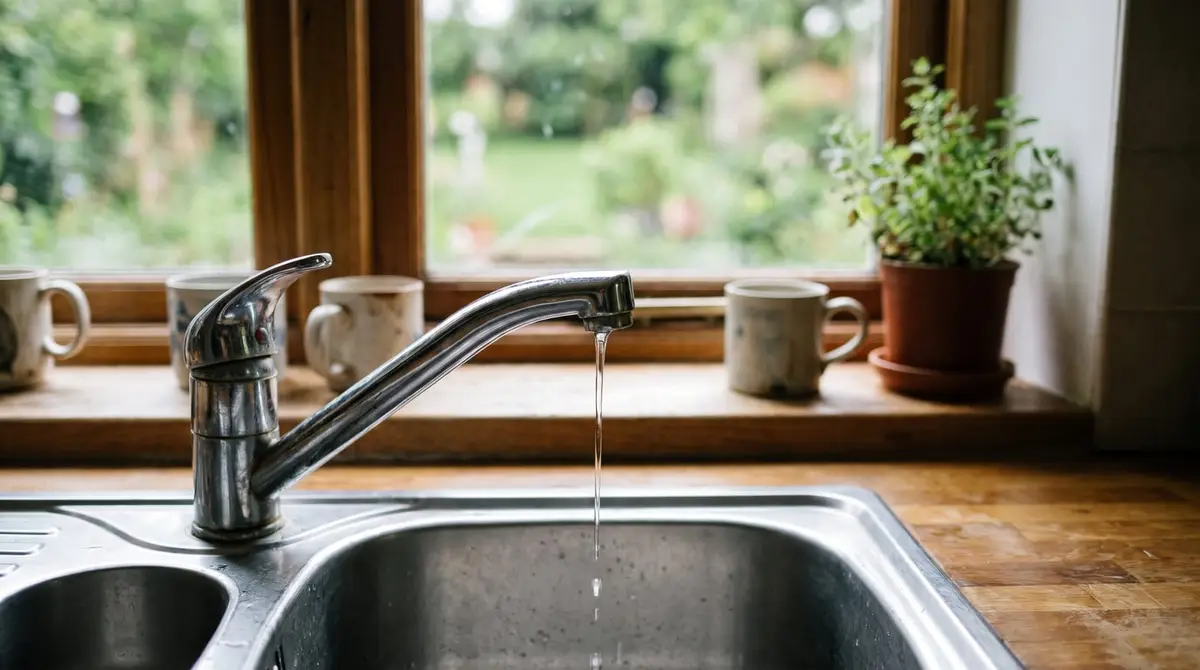
On a well, you make your own water pressure: the pump fills the tank, and the pressure switch decides when to stop. So when the shower goes weak, the gauge by the tank is the place to start. Most home well switches are set at 30/50 or 40/60: the pump starts at the first number and stops at the second. If the gauge swings through that range, the trouble is in the house. If it stays low, it is in the well, the pump or the switch.
Call (229) 520-5205Rather not call? Send the detailsCalls are answered 24/7. Weekdays 9 to 6 you may be put straight through to a local pro. Nights and weekends, if it can't wait, say so and we'll ring a local pro right away; otherwise a local pro will call you back the next business morning.
How do I read the pressure gauge?
- Find the gauge: It is the round dial on the pipe at the bottom of the pressure tank.
- Open one faucet: Watch the needle drop. On a 30/50 switch the pump should start around 30 psi; on a 40/60, around 40.
- Watch it climb: The needle should rise steadily and the pump should shut off around 50 or 60.
Normal numbers but a weak shower: look at filters, a softener, valves and old pipes in the house. Low numbers, or a needle that never reaches shut-off: the pump, the switch or the water level in the well is the problem.
Why is my well pressure low in Tift County?
Iron is a common culprit here. Georgia's geologic survey found local cases of excess iron in well water across Tift and its neighbors, and UGA Extension estimates 15% to 20% of private wells in every region of Georgia have high iron or manganese. Iron settles out in filters, softeners and faucet screens and slowly chokes the flow.
Iron bacteria make it worse. UGA Extension says these bacteria build a slime that can clog an entire well system in a few months, leaving orange or reddish water and slimy deposits in the toilet tank.
Sand from the well can wear the pump and plug screens. The sand and clay that lie over the limestone here run from under 50 feet thick to several hundred, and a well whose casing or screen has failed lets some of it in.
A tired pump or a low water level shows up as a pump that runs a long time without reaching shut-off. That is more likely late in a dry summer, when farm irrigation is pulling on the same limestone.
A waterlogged tank feels like low pressure that comes and goes in a rhythm. The pressure tank page shows the quick check.
Why does the pump come on when no one is using water?
Somewhere, water is escaping. A check valve that leaks lets water drain back down the well. A running toilet, a dripping hose bib or a broken line between the well and the house does the same.
With every tap off, watch the gauge for 15 minutes. If the needle sinks and the pump starts, there is a leak. Check toilets first: a few drops of food coloring in the tank that show up in the bowl without a flush mean it leaks. Then look at hose bibs, and walk the line from the well to the house for a soggy patch.
What does fixing low pressure cost?
A new filter cartridge costs little. As rough 2026 Georgia prices from SepticAndWell.com, a pressure switch replacement runs $150 to $350, a pressure tank replacement $300 to $800, and a leak in the pipe down the well $300 to $1,500. If the pump itself is worn, the pump replacement page has its range.
Iron or iron bacteria call for a water test and the right treatment, not only a new part. UGA's lab runs a basic test for pH, hardness, iron and manganese for about $20.
Common questions
Can I just turn the pressure switch up?
Not without checking two things: that the pump can reach the higher shut-off, and that the tank air is reset to match. Otherwise the pump may run without stopping.
Why is one faucet weak but the rest are fine?
That is almost always the faucet: a clogged aerator or cartridge, often with iron or sand in it. Unscrew the aerator and rinse it.
Will a water softener lower my pressure?
A plugged or undersized one can. Put it in bypass for a minute and compare.
Sources: Georgia Geologic Survey, T. W. Watson, The geohydrology of Ben Hill, Irwin, Tift, Turner, and Worth Counties, Hydrologic Atlas 2 (1976) (source); UGA Extension Bulletin 1563, Oxidizing filters (2024) (source); UGA Extension Bulletin 1457, Iron, manganese and sulfur bacteria in your well water (source); U.S. Geological Survey, Water-Resources Investigations Report 87-4145, Upper Floridan aquifer, Albany area (Tifton Upland water levels) (source); Goulds Water Technology, Jet pump installation manual (switch settings) (source); U.S. EPA WaterSense, Fix a Leak Week (toilet dye test) (source); UGA Agricultural and Environmental Services Laboratories, Water test prices (source); SepticAndWell.com, Georgia well pump repair cost (updated April 10, 2026) (source).
Last reviewed November 11, 2026.
Rather not call? Send the details
A local well pump pro will call you back.