Well inspections for home buyers in Tifton and Tift County
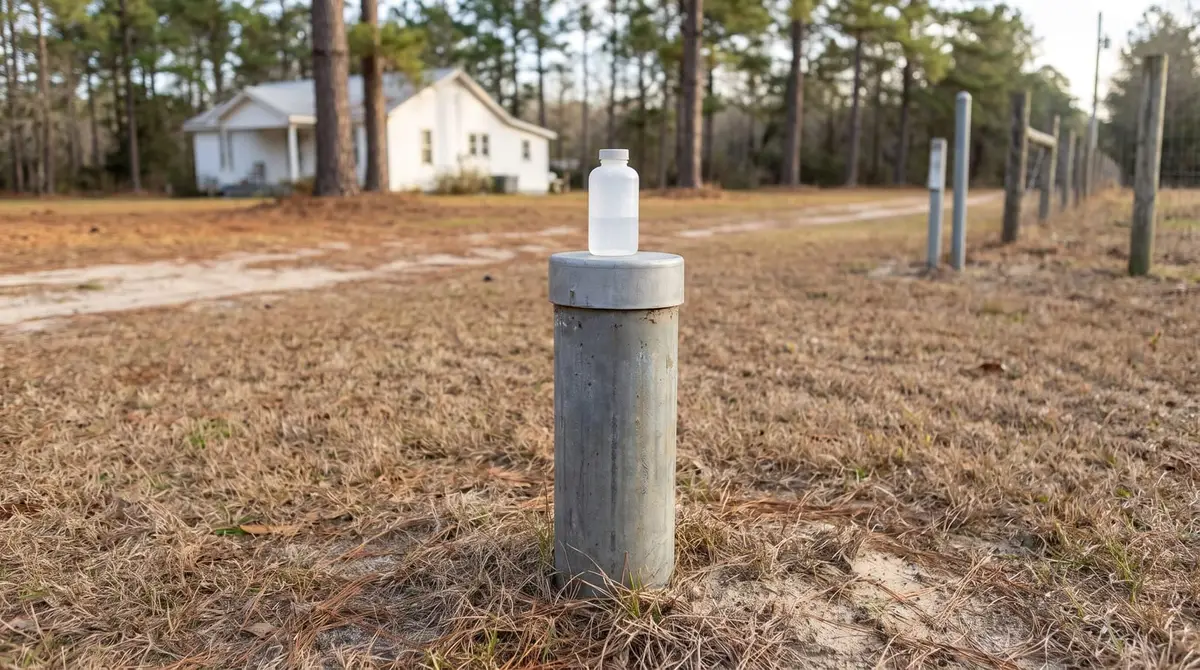
Buying a house on a well in Tift County? Georgia doesn't make the seller test it, but your lender may: FHA and VA loans can call for a water test, and VA wants results less than 90 days old. A standard well inspection runs about $300 to $600 nationally (Angi), and UGA's lab charges about $90 for a home-loan water test. An inspection looks at the pump and tank, how much water the well gives, what is in the water, and where the well sits.
Call (229) 520-5205Rather not call? Send the detailsCalls are answered 24/7. Weekdays 9 to 6 you may be put straight through to a local pro. Nights and weekends, if it can't wait, say so and we'll ring a local pro right away; otherwise a local pro will call you back the next business morning.
Does Georgia require a well inspection to sell a house?
A lot of Tift County homes are on their own wells: the USGS counted about 11,500 people, 28.7% of the county, supplying their own water in 2010, and more than half the people in neighboring Worth, Irwin and Berrien counties. Nobody checks those wells but the owner.
And no state rule makes them. Georgia's Department of Public Health says private wells in Georgia are not subject to any regulatory authority, so a seller doesn't have to inspect or test one.
Your lender may. FHA calls for a water test on new construction, when the appraiser reports a problem with the water, and on homes near dumps, landfills, industrial sites or farms where pesticides are used, which covers plenty of homes in farm country like Tift County. VA wants the water to meet the local health authority's standards, tested by a disinterested third party, with results good for 90 days. UGA Extension adds that some lenders want lead, nitrate and bacteria results before approving a mortgage.
What does a well inspection include?
- Equipment: Pump, pressure tank, switch, gauge and wiring: does the pump start, stop and hold pressure?
- Flow: Water is run for a set time to measure gallons per minute and whether the system keeps up.
- Water quality: A lab sample, at least for coliform bacteria and nitrate, and in this area, iron and manganese too.
- The wellhead and location: The cap and casing above ground, and the distance to the septic tank, drain field and any animal pens.
A general home inspector may skip the well entirely, and the lab water test is often a separate charge. Ask which of these four a quote covers.
What should I test the water for in Tift County?
Bacteria and nitrate first, since lenders ask for them and farm country can affect both. Then iron and manganese: the state geologic survey found local cases of excess iron in this area's wells, and UGA estimates 15% to 20% of Georgia private wells have high iron or manganese. If the water smells like rotten eggs, ask about hydrogen sulfide; UGA notes it is hard to measure in a lab and is often checked on site.
Tifton also sits on the north edge of a buried feature geologists call the Gulf Trough. The state geologic survey found high natural radioactivity in some wells in and near it, with the highest levels around Tifton and Alapaha, and Tifton took one city well out of service for it. Not every well in the trough has it. UGA Extension notes that tests for radium and radon can be added when a natural source is suspected, so ask the lab about one if you are buying near Tifton.
UGA's lab prices, as listed in 2026: a home-loan closing test (lead, nitrate, nitrite, coliform and E. coli) about $90, a bacteria test about $40, and a basic test for pH, hardness, iron and manganese about $20. After closing, Georgia's health department recommends a coliform test every year and a chemical screening every 3 years, and notes that arsenic has been found at elevated levels in some South Georgia wells.
How much water should the well give?
Penn State Extension suggests a minimum of about 6 gallons per minute for most single-family homes. New York's health department uses 5 gallons per minute, two fixtures running at once, as a peak-demand estimate.
A one-day flow test shows what the system gives that day. Ask the sellers for the original drilling record and any pump invoices, which tell you how deep the well is and where the pump hangs.
How far must a well be from the septic system in Georgia?
| From | At least |
|---|---|
| Septic tank | 50 feet |
| Drain field | 100 feet |
| Cesspool or seepage pit | 150 feet |
| Animal or poultry enclosure | 100 feet |
FHA uses the same 50 and 100 feet for existing homes. Georgia law also has the driller hand the owner the well's construction data within 30 days of finishing it; ask the sellers whether they kept it.
What does a well inspection cost?
Nationally, Angi puts a standard well inspection at about $300 to $600, and the UGA lab charges about $90 for a home-loan water test.
| Service | Rough cost | Where the number comes from |
|---|---|---|
| Standard well inspection | $300 to $600 (about $450 average) | Angi, national |
| Comprehensive inspection | $700 to $750 | Angi, national |
| UGA home-loan water test | $90 | UGA lab |
| UGA bacteria test | $40 | UGA lab |
| UGA basic test (pH, hardness, iron, manganese) | $20 | UGA lab |
Get the parts of the inspection in writing so quotes can be compared.
Common questions
Can the seller collect the water sample?
Not for an FHA loan: HUD says the borrower, owner or other interested party may not collect or carry it. VA also requires a disinterested third party.
What if the test shows bacteria?
Usually the well is shock chlorinated, flushed and retested. Repeated positive tests point to a problem with the cap, the casing or the well's location.
How often should I have the well inspected after I move in?
Penn State Extension suggests a professional inspection at least every 10 years, with a bacteria test every year.
Sources: U.S. Geological Survey, Open-File Report 2015-1230, Water use in Georgia by county for 2010 (Tables 9 and 10) (source); Georgia Department of Public Health, Well water fact sheet (2023) (source); HUD Handbook 4000.1, FHA single family housing policy (individual water systems) (source); VA Lender's Handbook, Chapter 12, Minimum property requirements (source); UGA Extension Circular 858-2, Testing for water quality (2026) (source); UGA Agricultural and Environmental Services Laboratories, Water test prices (source); UGA Extension Bulletin 1563, Oxidizing filters (2024) (source); UGA Extension Circular 858-8, Hydrogen sulfide and sulfate (2026) (source); Georgia Geologic Survey, T. W. Watson, The geohydrology of Ben Hill, Irwin, Tift, Turner, and Worth Counties, Hydrologic Atlas 2 (1976) (source); Georgia EPD, Bulletin 94, Hydrogeology of the Gulf Trough–Apalachicola Embayment area (Kellam and Gorday, 1990) (source); U.S. Geological Survey, Scientific Investigations Report 2010-5072, Geohydrology of the Aucilla-Suwannee-Ochlockonee River Basin (natural radioactivity in Tift and Berrien Counties) (source); Georgia Code § 12-5-134 (drilling notice, setbacks, well construction data) (source); Penn State Extension, Water system planning: estimating water needs (source); Penn State Extension, Best management practices for private water wells (source); New York State Department of Health, Fact sheet 2: individual water supply wells and storage (source); Angi, Well inspection cost (October 2026) (source).
Last reviewed November 11, 2026.
Rather not call? Send the details
A local well pump pro will call you back.